Subscriptions
Restructuring subscription management for scale, clarity, and control
Role: Design Lead + Mentor
Scope: Research framing, system restructuring, validation strategy, mentorship
Phases: Research → Structural Redesign
Problem Space
Subscriptions were central to how subscription notifications were delivered across xMatters. But the experience had fragmented over time:
- Admins had to manage subscriptions user-by-user
- No bulk management capabilities
- Outdated tables and filtering patterns
- Limited visibility into why someone was subscribed
- Confusing search logic requiring exact attribute matching
- Poor discoverability of the Subscriptions surface
The system technically worked - but it did not scale for enterprise usage.
Strategic Context
Phase 1 research surfaced a pattern: This was not just a “UI polish” problem. It was a structural management model problem.
After reviewing the research report, the PM and I aligned on three critical shifts:
- Tables needed modernization (search, filter, bulk action patterns)
- Admins needed a centralized subscription management surface
- End users needed clearer self-service and visibility
From this, we split the future direction into two distinct focus areas:
- My Subscriptions (End-user clarity and self-serve control)
- Subscription Management (Admin-level bulk management and oversight)
This reframing moved the work from incremental improvement to platform restructuring.
Phase 1: Research & Diagnosis
I structured the research alongside a junior designer and researcher. My contributions:
- Defined scope and research goals
- Co-created the interview script
- Defined recruitment criteria
- Tagged and analysed subscription behavior in Pendo
- Provided early behavioral analysis
- Guided synthesis and insight framing
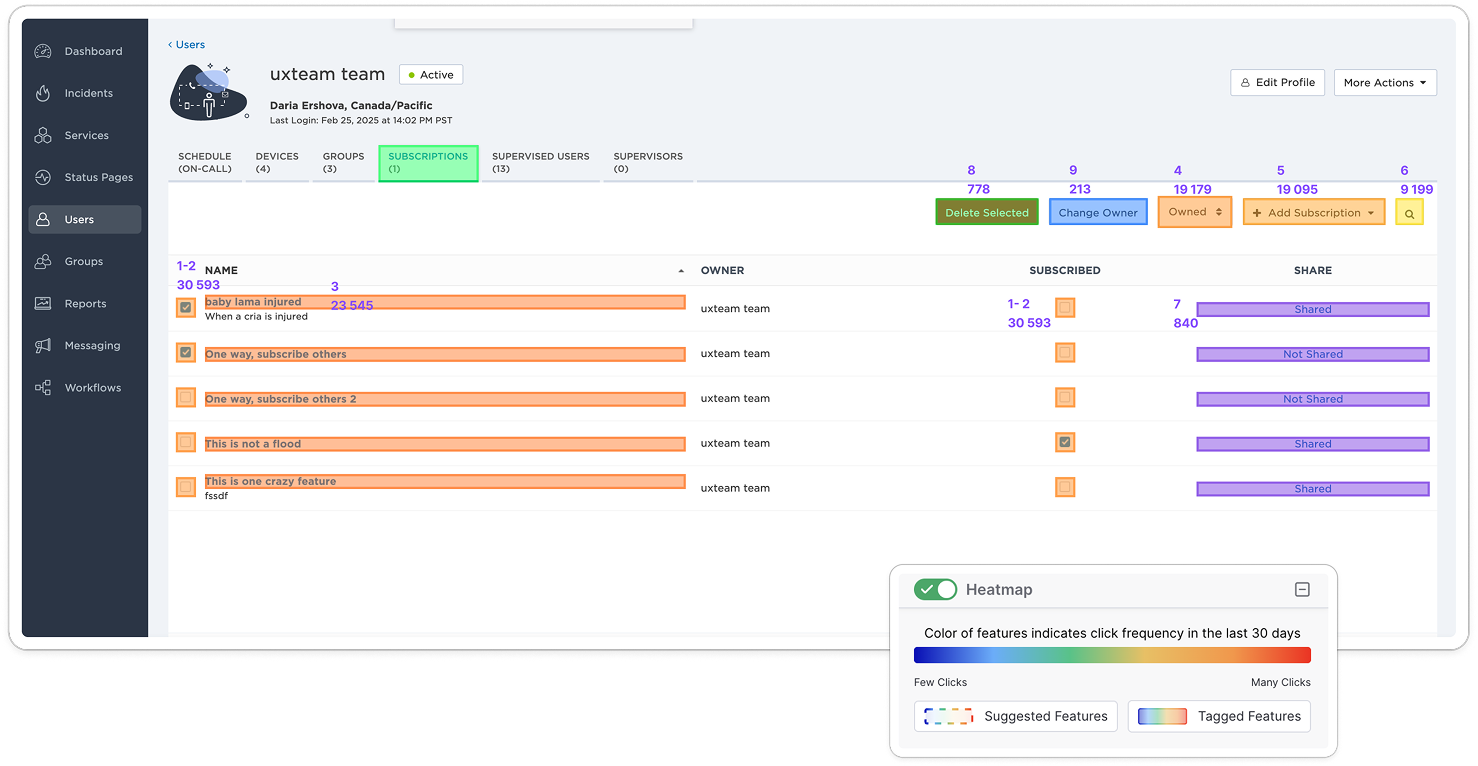
Key Findings
Reporting & Audit Needs
- Admins need operational reporting
- Audit and export capabilities are critical
- Need for filtering and drill-down
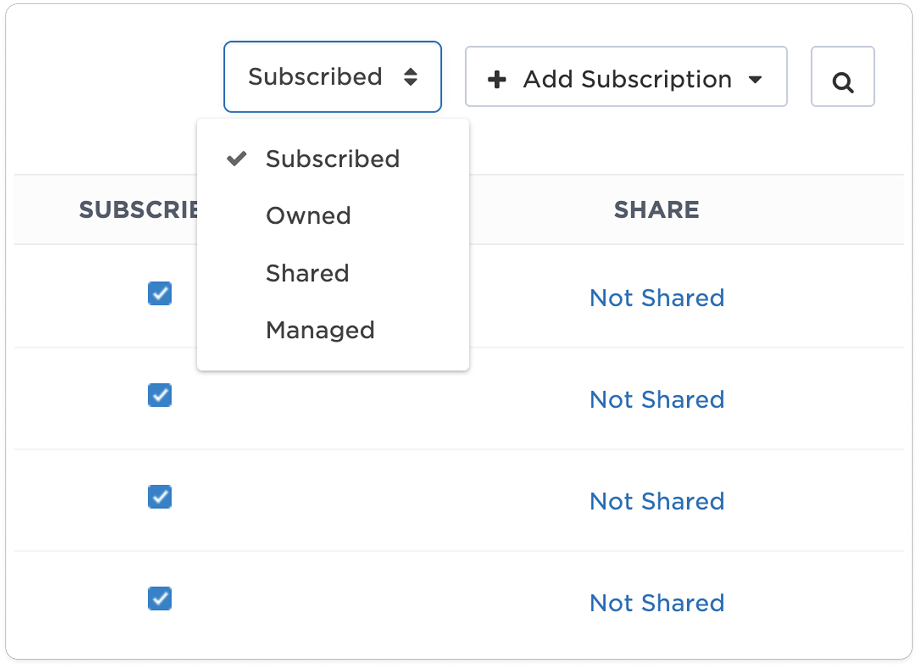
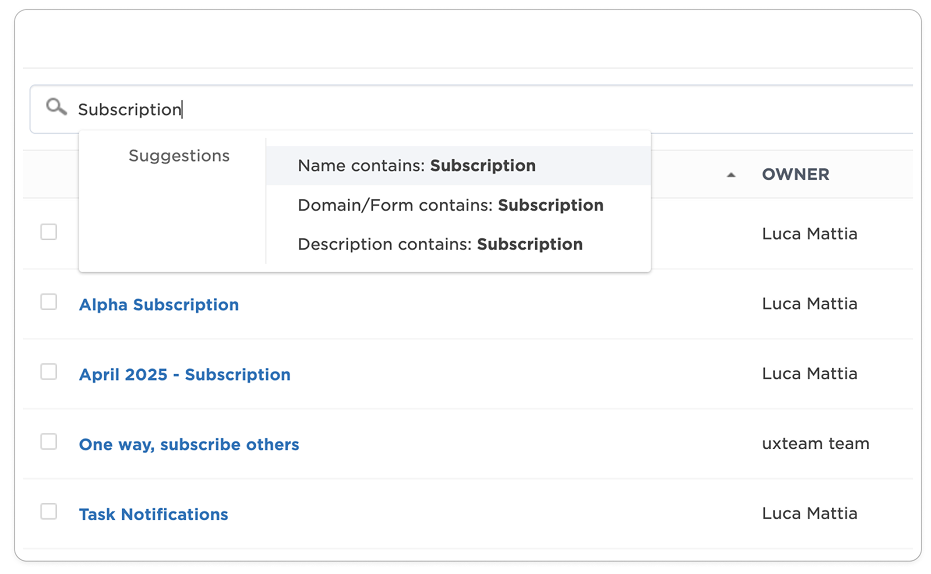
Search & Filtering Friction
- Search required specifying exact attributes
- Results did not update dynamically
- Filtering state did not persist
Navigation & Discoverability Issues
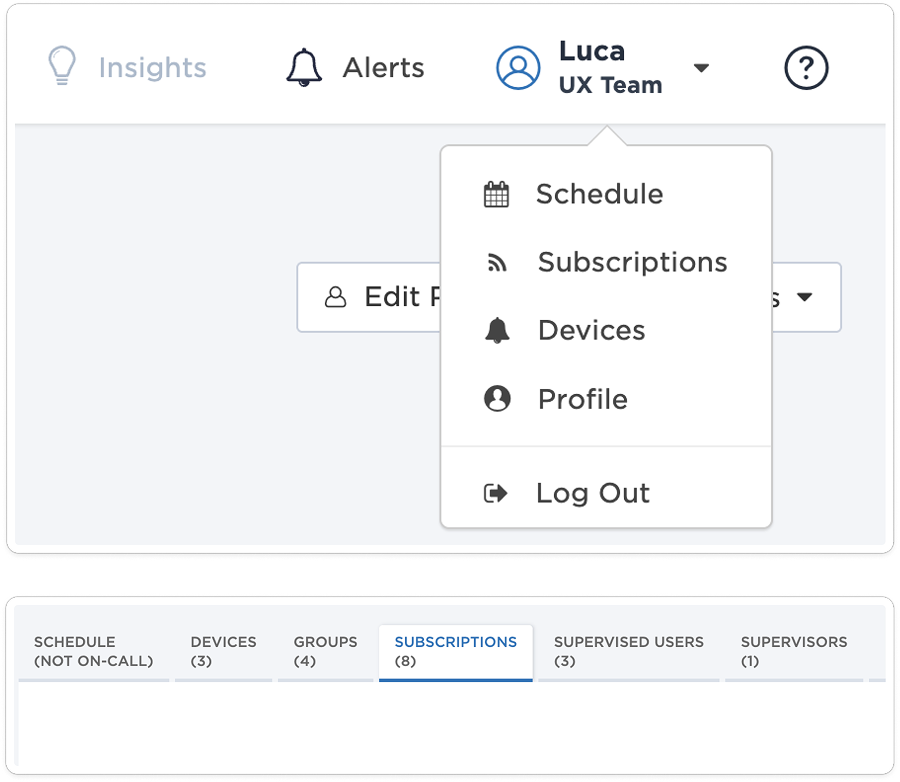
- Subscriptions buried inside user profile
- Users unsure where to manage subscriptions
- No centralized admin control
Management Model Misalignment
Customers operate under different governance models:
- Centralized admin control
- Automated group-based subscriptions
- Localized management
- Growing demand for end-user auto-subscribe
Strategic Reframe
The core issue was not “subscriptions are hard to use.” It was:
We were designing for two fundamentally different mental models.
Admins were forced into inefficient workflows.End users lacked transparency.The UI patterns reinforced fragmentation.
Our original architecture forced both personas into the same surface. That tension created friction for both.
The opportunity became:
- Introduce bulk subscription management for admins
- Separate self-service from governance
- Modernize tables and search patterns
- Clarify why users are subscribed
This became the foundation for Phase 2.
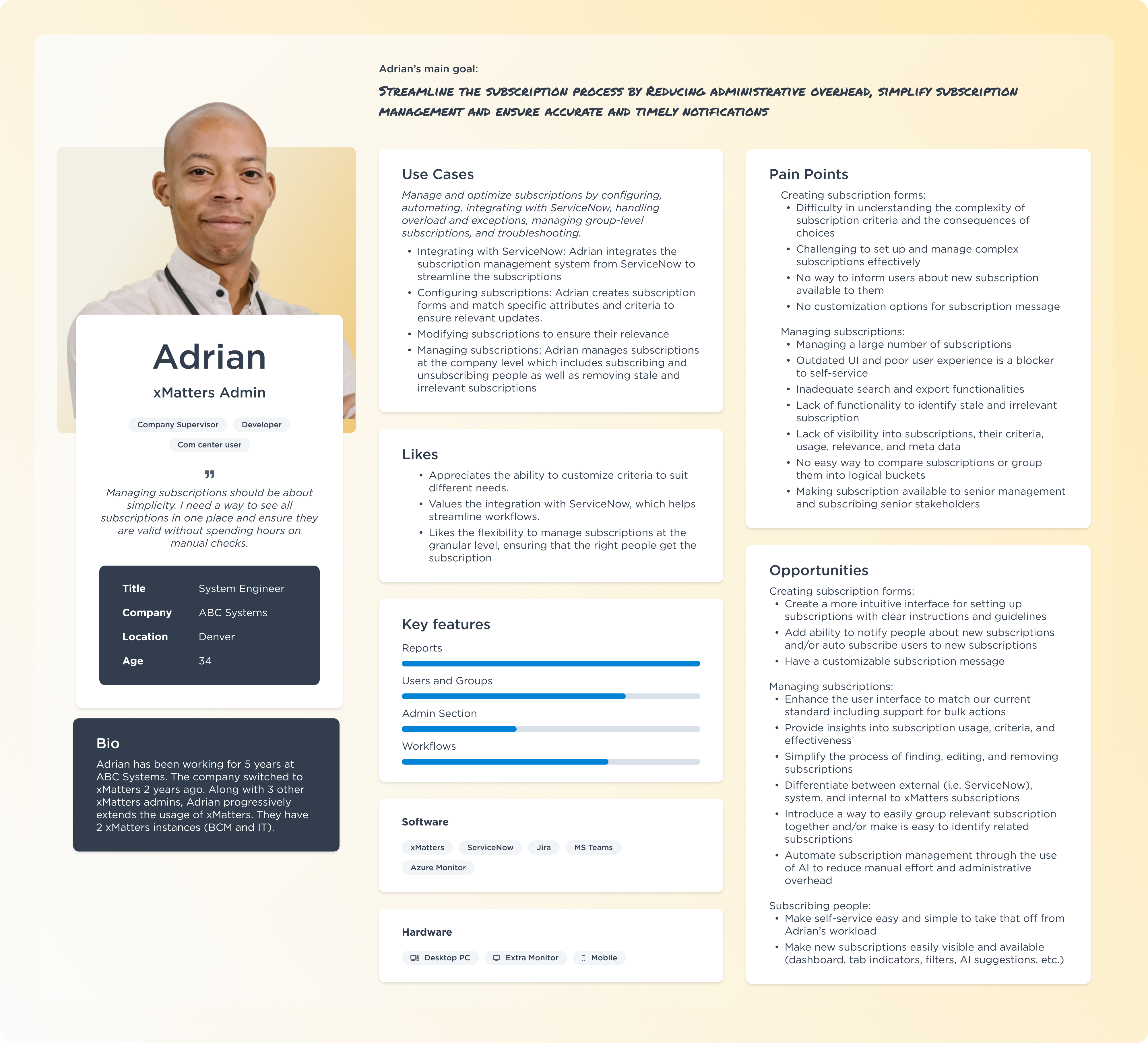
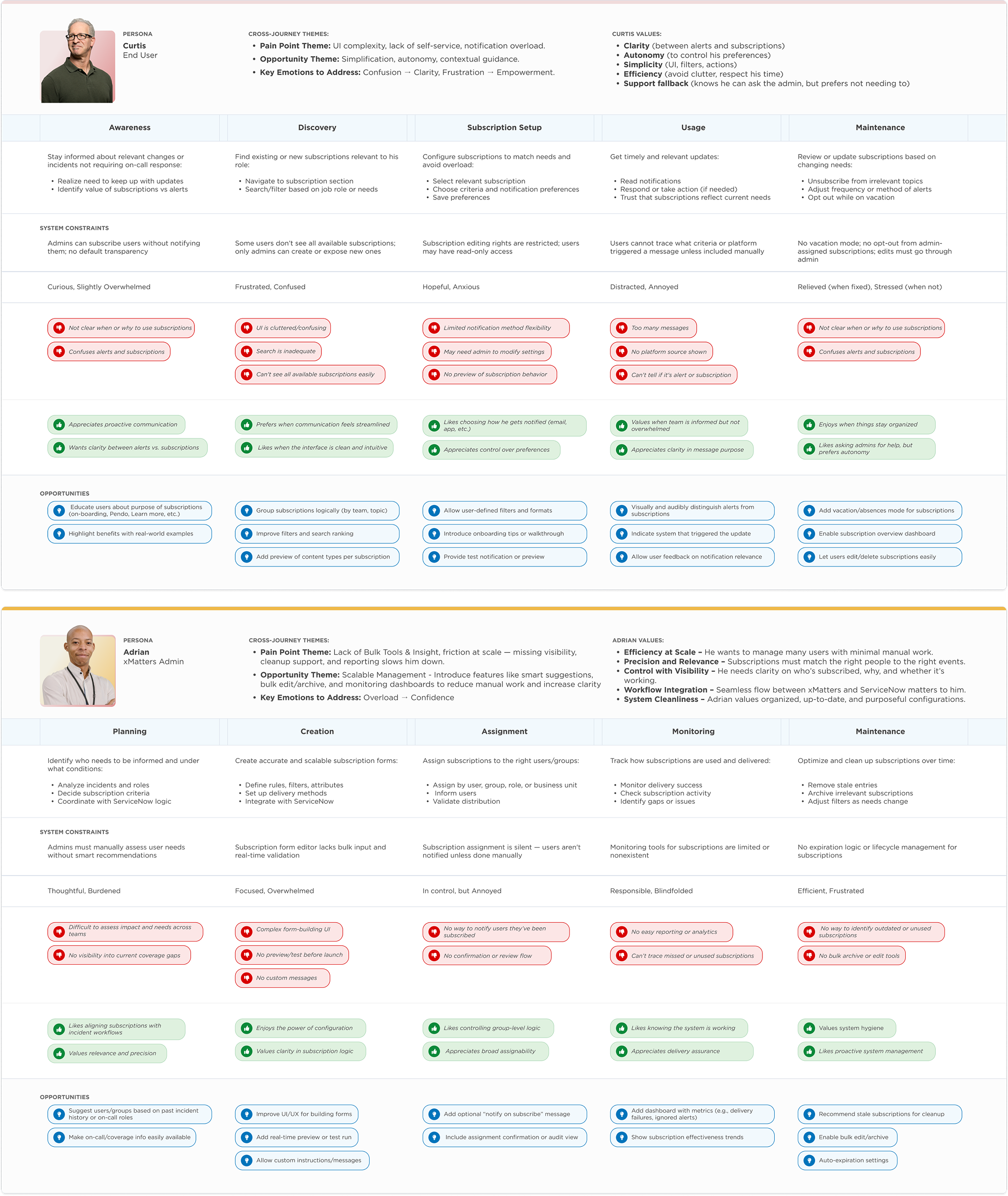
Persona 1: The Governance-Oriented Admin
- Responsible for compliance and accuracy
- Manages subscriptions across teams
- Needs bulk control and audit visibility
- Concerned with risk and governance
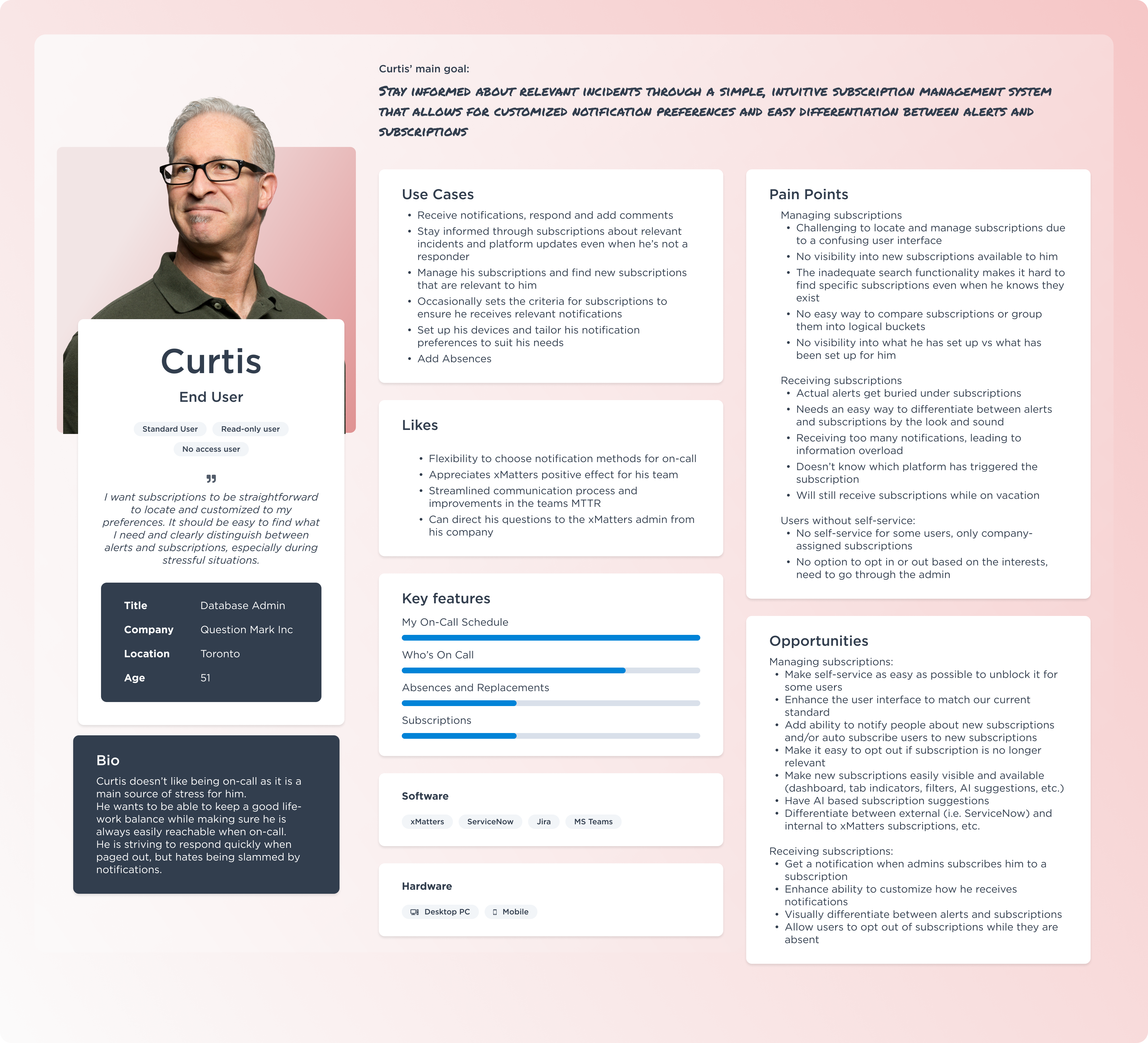
Persona 2: The Operational End User
- Wants clarity on what they’re subscribed to
- Needs simple opt-in / opt-out where allowed
- Doesn’t understand subscription logic
- Just wants confidence and visibility
Journey Friction Moment
The key breakthrough was recognizing that subscriptions were serving two fundamentally different user needs: individual visibility and organizational governance.
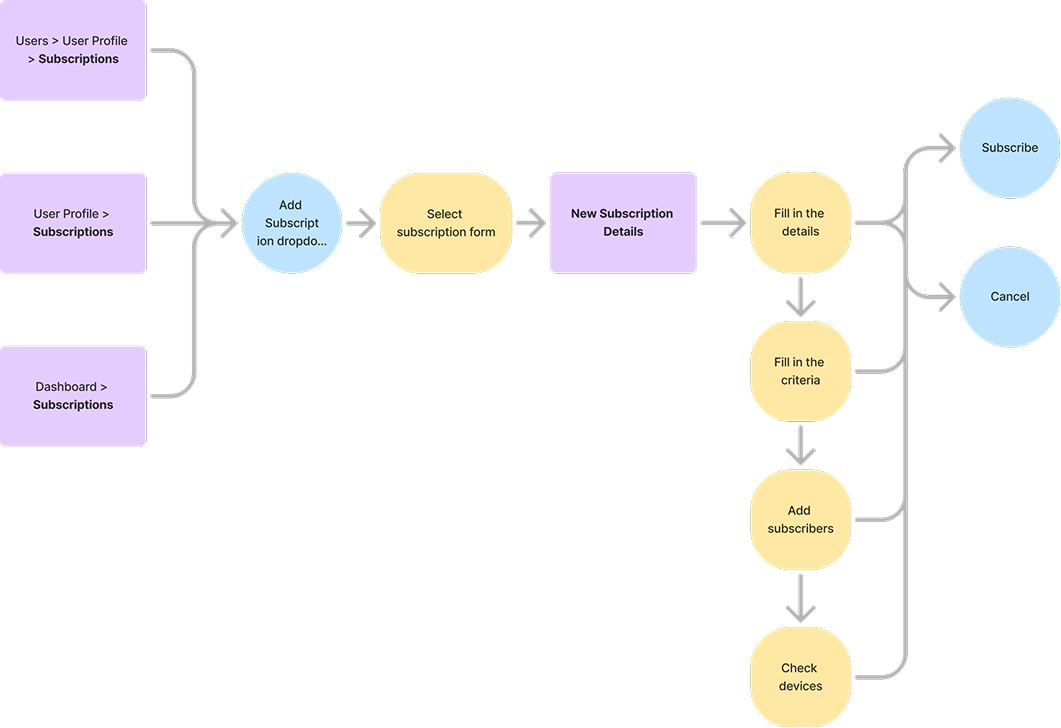
For admins managing large organizations, subscription changes required visiting each user profile individually.
A simple action like:
- Removing access to a subscription across a team
- Auditing who is subscribed to a sensitive notification
- Updating delivery logic
…required repetitive, manual navigation.
This created:
- High cognitive load
- Increased risk of error
- No visibility across the system
Meanwhile, end users couldn’t clearly understand:
- Why they were subscribed
- Whether they could change it
- Who controlled the subscription
Both personas were constrained by the same surface - but needed fundamentally different controls.
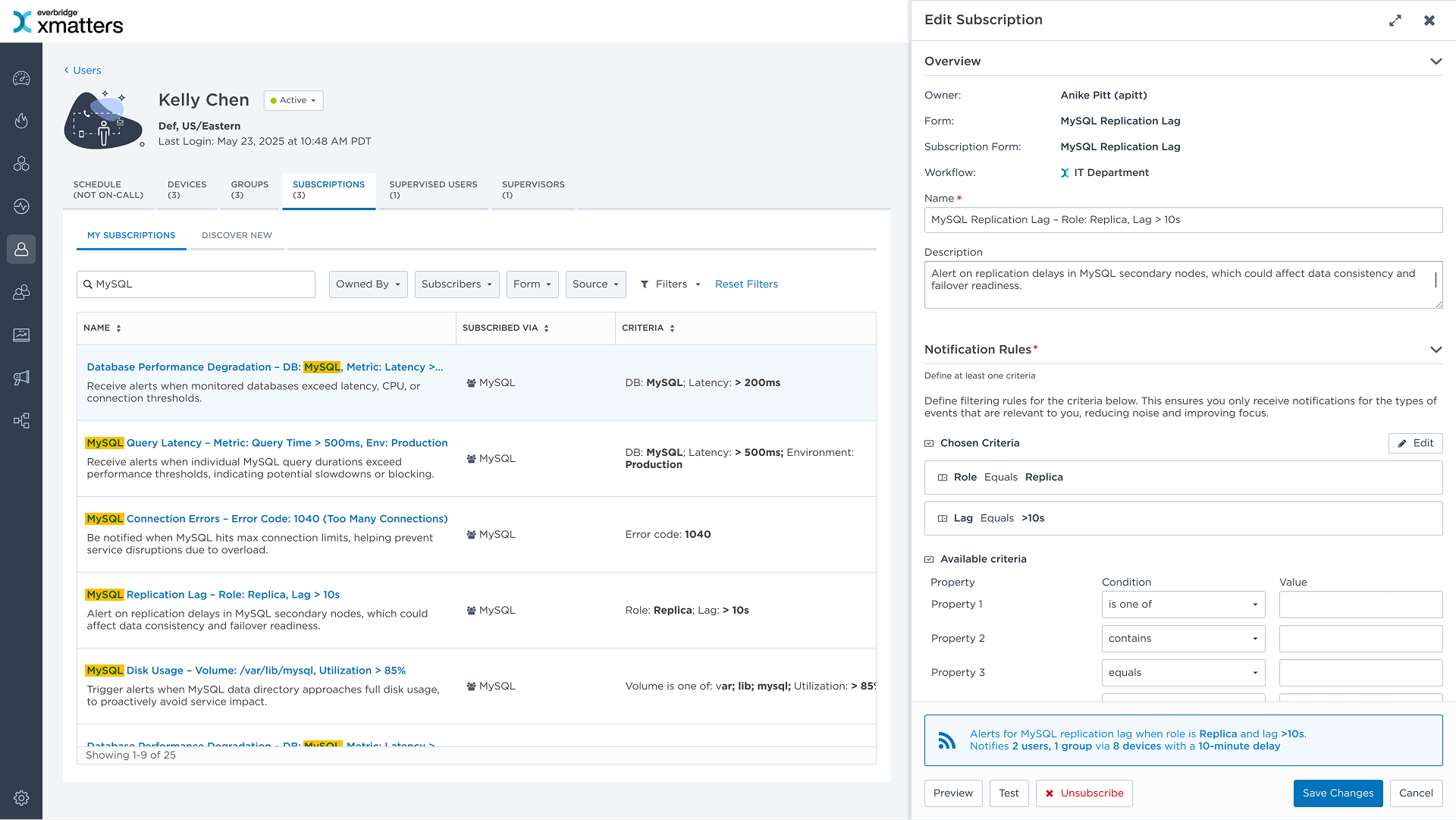
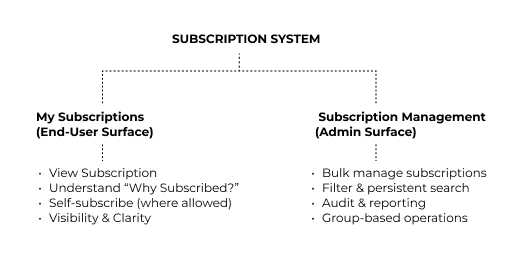
Instead of iterating on a single surface, we introduced a dual-surface model that separated self-service from administrative control
Phase 2: Structural Redesign
We split ownership intentionally. My Focus: Structural & System Direction
- Defined the two-surface model:
- My Subscriptions
- Subscription Management
- Created wireframes for one of the core areas
- Built the interactive prototype
- Created validation script
- Defined hypotheses around bulk actions and governance models
Junior Designer Focus:
- Owned the second area
- Conducted usability testing
- Synthesized findings
- Delivered high-fidelity production mocks
I shaped the synthesis and reframed results where needed, ensuring alignment with system constraints and long-term scalability. I stepped back from pixel execution while ensuring coherence and direction.
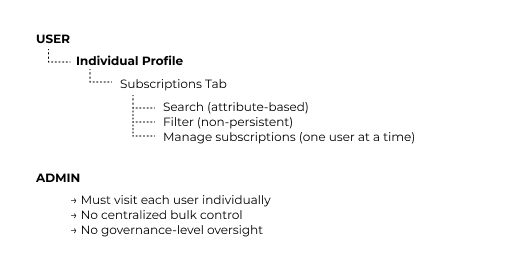
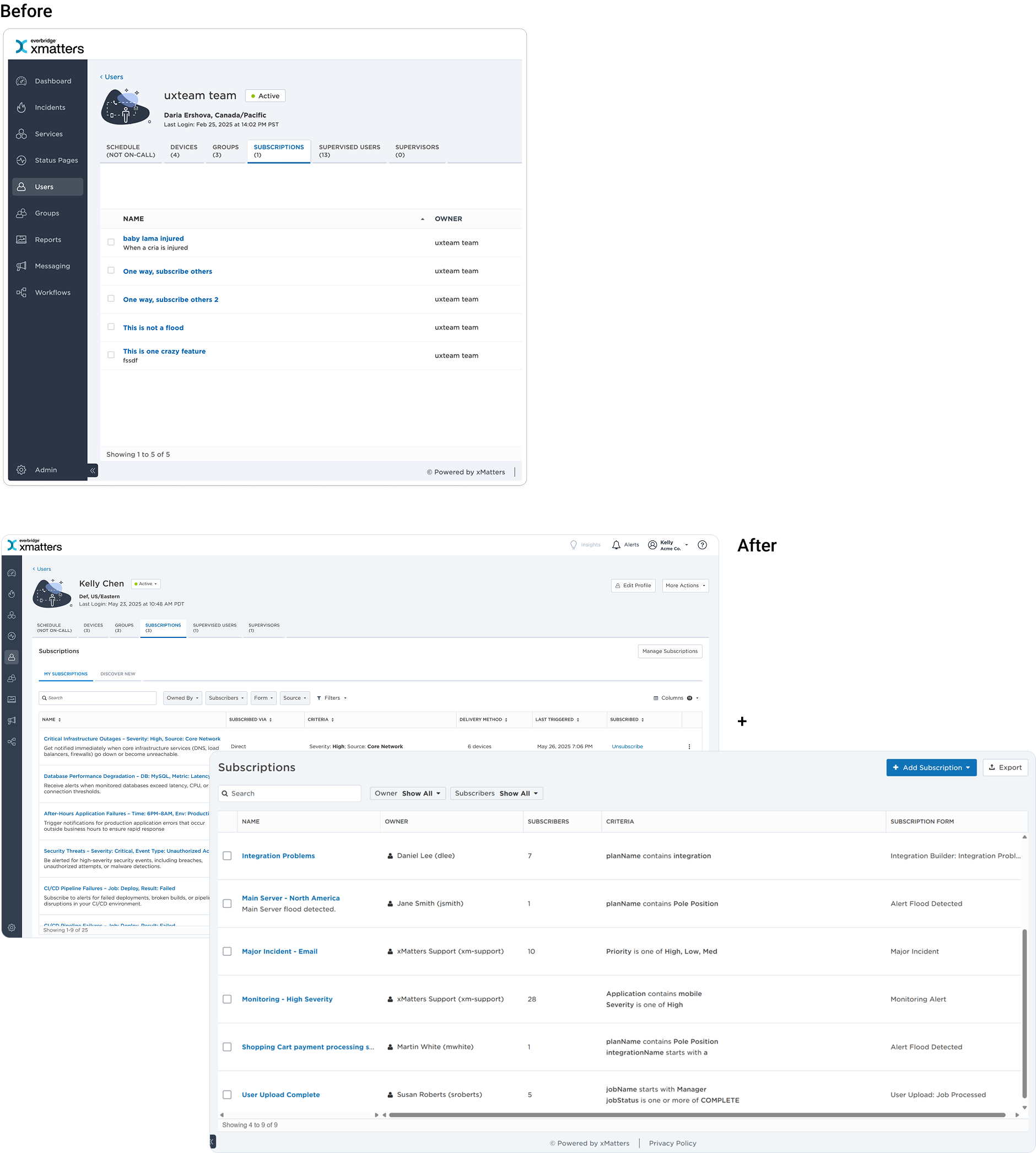
Before: Fragmented & User-Centric Only
Characteristics:
- User-by-user management
- No bulk actions
- Search required exact attribute targeting
- No clear governance model
- Subscriptions buried in profile navigation
- No transparency into subscription rationale
After: Dual-Surface Management Model
Principles Introduced:
- Separation of self-service and governance
- Bulk-first administration
- Persistent filtering and scalable tables
- Clear subscription logic visibility
- Support for multiple governance models
Design Principles Introduced
- Bulk-first management for admins
- Persistent filtering and modern table behavior
- Clear subscription rationale (“Why am I subscribed?”)
- Easier new subscription discovery and self service
- Explicit governance model support
- Scalable search patterns
Outcome
- Reduced strategic risk before major investment
- Clarified the role and scope of Insights within the product ecosystem
- Aligned executive ambition with customer validation
- Established a structured continuation plan
This project reinforced that executive-facing design requires defining signal, trust, and decision clarity in ambiguous spaces.
Daria Ershova

Subscriptions
Restructuring subscription management for scale, clarity, and control
Role: Design Lead + Mentor
Scope: Research framing, system restructuring, validation strategy, mentorship
Phases: Research → Structural Redesign
Problem Space
Subscriptions were central to how subscription notifications were delivered across xMatters. But the experience had fragmented over time:
- Admins had to manage subscriptions user-by-user
- No bulk management capabilities
- Outdated tables and filtering patterns
- Limited visibility into why someone was subscribed
- Confusing search logic requiring exact attribute matching
- Poor discoverability of the Subscriptions surface
The system technically worked - but it did not scale for enterprise usage.
Strategic Context
Phase 1 research surfaced a pattern: This was not just a “UI polish” problem. It was a structural management model problem.
After reviewing the research report, the PM and I aligned on three critical shifts:
- Tables needed modernization (search, filter, bulk action patterns)
- Admins needed a centralized subscription management surface
- End users needed clearer self-service and visibility
From this, we split the future direction into two distinct focus areas:
- My Subscriptions (End-user clarity and self-serve control)
- Subscription Management (Admin-level bulk management and oversight)
This reframing moved the work from incremental improvement to platform restructuring.
Phase 1: Research & Diagnosis
I structured the research alongside a junior designer and researcher. My contributions:
- Defined scope and research goals
- Co-created the interview script
- Defined recruitment criteria
- Tagged and analysed subscription behavior in Pendo
- Provided early behavioral analysis
- Guided synthesis and insight framing
Key Findings
Reporting & Audit Needs
- Admins need operational reporting
- Audit and export capabilities are critical
- Need for filtering and drill-down
Search & Filtering Friction
- Search required specifying exact attributes
- Results did not update dynamically
- Filtering state did not persist
Navigation & Discoverability Issues
- Subscriptions buried inside user profile
- Users unsure where to manage subscriptions
- No centralized admin control
Management Model Misalignment
Customers operate under different governance models:
- Centralized admin control
- Automated group-based subscriptions
- Localized management
- Growing demand for end-user auto-subscribe
Strategic Reframe
The core issue was not “subscriptions are hard to use.” It was:
We were designing for two fundamentally different mental models.
Admins were forced into inefficient workflows.End users lacked transparency.The UI patterns reinforced fragmentation.
Our original architecture forced both personas into the same surface. That tension created friction for both.
The opportunity became:
- Introduce bulk subscription management for admins
- Separate self-service from governance
- Modernize tables and search patterns
- Clarify why users are subscribed
This became the foundation for Phase 2.
Persona 1: The Governance-Oriented Admin
- Responsible for compliance and accuracy
- Manages subscriptions across teams
- Needs bulk control and audit visibility
- Concerned with risk and governance
Persona 2: The Operational End User
- Wants clarity on what they’re subscribed to
- Needs simple opt-in / opt-out where allowed
- Doesn’t understand subscription logic
- Just wants confidence and visibility
Journey Friction Moment
The key breakthrough was recognizing that subscriptions were serving two fundamentally different user needs: individual visibility and organizational governance.
For admins managing large organizations, subscription changes required visiting each user profile individually.
A simple action like:
- Removing access to a subscription across a team
- Auditing who is subscribed to a sensitive notification
- Updating delivery logic
…required repetitive, manual navigation.
This created:
- High cognitive load
- Increased risk of error
- No visibility across the system
Meanwhile, end users couldn’t clearly understand:
- Why they were subscribed
- Whether they could change it
- Who controlled the subscription
Both personas were constrained by the same surface - but needed fundamentally different controls.
Instead of iterating on a single surface, we introduced a dual-surface model that separated self-service from administrative control
Before: Fragmented & User-Centric Only
Characteristics:
- User-by-user management
- No bulk actions
- Search required exact attribute targeting
- No clear governance model
- Subscriptions buried in profile navigation
- No transparency into subscription rationale
After: Dual-Surface Management Model
Principles Introduced:
- Separation of self-service and governance
- Bulk-first administration
- Persistent filtering and scalable tables
- Clear subscription logic visibility
- Support for multiple governance models
Phase 2: Structural Redesign
We split ownership intentionally. My Focus: Structural & System Direction
- Defined the two-surface model:
- My Subscriptions
- Subscription Management
- Created wireframes for one of the core areas
- Built the interactive prototype
- Created validation script
- Defined hypotheses around bulk actions and governance models
Junior Designer Focus:
- Owned the second area
- Conducted usability testing
- Synthesized findings
- Delivered high-fidelity production mocks
I shaped the synthesis and reframed results where needed, ensuring alignment with system constraints and long-term scalability. I stepped back from pixel execution while ensuring coherence and direction.
Design Principles Introduced
- Bulk-first management for admins
- Persistent filtering and modern table behavior
- Clear subscription rationale (“Why am I subscribed?”)
- Easier new subscription discovery and self service
- Explicit governance model support
- Scalable search patterns
Daria Ershova
Subscriptions
Restructuring subscription management for scale, clarity, and control
Role: Design Lead + Mentor
Scope: Research framing, system restructuring, validation strategy, mentorship
Phases: Research → Structural Redesign
Problem Space
Subscriptions were central to how subscription notifications were delivered across xMatters. But the experience had fragmented over time:
- Admins had to manage subscriptions user-by-user
- No bulk management capabilities
- Outdated tables and filtering patterns
- Limited visibility into why someone was subscribed
- Confusing search logic requiring exact attribute matching
- Poor discoverability of the Subscriptions surface
The system technically worked - but it did not scale for enterprise usage.
Strategic Context
Phase 1 research surfaced a pattern: This was not just a “UI polish” problem. It was a structural management model problem.
After reviewing the research report, the PM and I aligned on three critical shifts:
- Tables needed modernization (search, filter, bulk action patterns)
- Admins needed a centralized subscription management surface
- End users needed clearer self-service and visibility
From this, we split the future direction into two distinct focus areas:
- My Subscriptions (End-user clarity and self-serve control)
- Subscription Management (Admin-level bulk management and oversight)
This reframing moved the work from incremental improvement to platform restructuring.
Phase 1: Research & Diagnosis
I structured the research alongside a junior designer and researcher. My contributions:
- Defined scope and research goals
- Co-created the interview script
- Defined recruitment criteria
- Tagged and analyses subscription behaviour in Pendo
- Provided early behavioural analysis
- Guided synthesis and insight framing including the creation of user journeys and personas
Key Findings
Reporting & Audit Needs
- Admins need operational reporting
- Audit and export capabilities are critical
- Need for filtering and drill-down
Search & Filtering Friction
- Search required specifying exact attributes
- Results did not update dynamically
- Filtering state did not persist
Navigation & Discoverability Issues
- Subscriptions buried inside user profile
- Users unsure where to manage subscriptions
- No centralized admin control
Management Model Misalignment
Customers operate under different governance models:
- Centralized admin control
- Automated group-based subscriptions
- Localized management
- Growing demand for end-user auto-subscribe
Strategic Reframe
The core issue was not “subscriptions are hard to use.” It was:
We were designing for two fundamentally different mental models.
Admins were forced into inefficient workflows.End users lacked transparency.The UI patterns reinforced fragmentation.
Our original architecture forced both personas into the same surface. That tension created friction for both.
The opportunity became:
- Introduce bulk subscription management for admins
- Separate self-service from governance
- Modernize tables and search patterns
- Clarify why users are subscribed
This became the foundation for Phase 2.
Persona 1: The Governance-Oriented Admin
- Responsible for compliance and accuracy
- Manages subscriptions across teams
- Needs bulk control and audit visibility
- Concerned with risk and governance
Persona 2: The Operational End User
- Wants clarity on what they’re subscribed to
- Needs simple opt-in / opt-out where allowed
- Doesn’t understand subscription logic
- Just wants confidence and visibility
Journey Friction Moment
The key breakthrough was recognizing that subscriptions were serving two fundamentally different user needs: individual visibility and organizational governance.
For admins managing large organizations, subscription changes required visiting each user profile individually.
A simple action like:
- Removing access to a subscription across a team
- Auditing who is subscribed to a sensitive notification
- Updating delivery logic
…required repetitive, manual navigation.
This created:
- High cognitive load
- Increased risk of error
- No visibility across the system
Meanwhile, end users couldn’t clearly understand:
- Why they were subscribed
- Whether they could change it
- Who controlled the subscription
Both personas were constrained by the same surface - but needed fundamentally different controls.
Instead of iterating on a single surface, we introduced a dual-surface model that separated self-service from administrative control
Before: Fragmented & User-Centric Only
Characteristics:
- User-by-user management
- No bulk actions
- Search required exact attribute targeting
- No clear governance model
- Subscriptions buried in profile navigation
- No transparency into subscription rationale
After: Dual-Surface Management Model
Principles Introduced:
- Separation of self-service and governance
- Bulk-first administration
- Persistent filtering and scalable tables
- Clear subscription logic visibility
- Support for multiple governance models
Phase 2: Structural Redesign
We split ownership intentionally. My Focus: Structural & System Direction
- Defined the two-surface model:
- My Subscriptions
- Subscription Management
- Created wireframes for one of the core areas
- Built the interactive prototype
- Created validation script
- Defined hypotheses around bulk actions and governance models
Junior Designer Focus:
- Owned the second area
- Conducted usability testing
- Synthesized findings
- Delivered high-fidelity production mocks
I shaped the synthesis and reframed results where needed, ensuring alignment with system constraints and long-term scalability. I stepped back from pixel execution while ensuring coherence and direction.
Design Principles Introduced
- Bulk-first management for admins
- Persistent filtering and modern table behaviour
- Clear subscription rationale (“Why am I subscribed?”)
- Easier new subscription discovery and self service
- Explicit governance model support
- Scalable search patterns
Outcome
- Clear separation between self-service and governance
- Defined roadmap for scalable subscription management
- Research-backed prioritization
- Strong growth opportunity for junior designer
- Strong alignment between PM and Design