Insights
Shaping product direction through executive collaboration
Role: Design Lead (Strategic Contributor)
Scope: Concept development, validation strategy, direction setting, executive collaboration
Context: Early-stage initiative with CPO & CTO
Problem Space
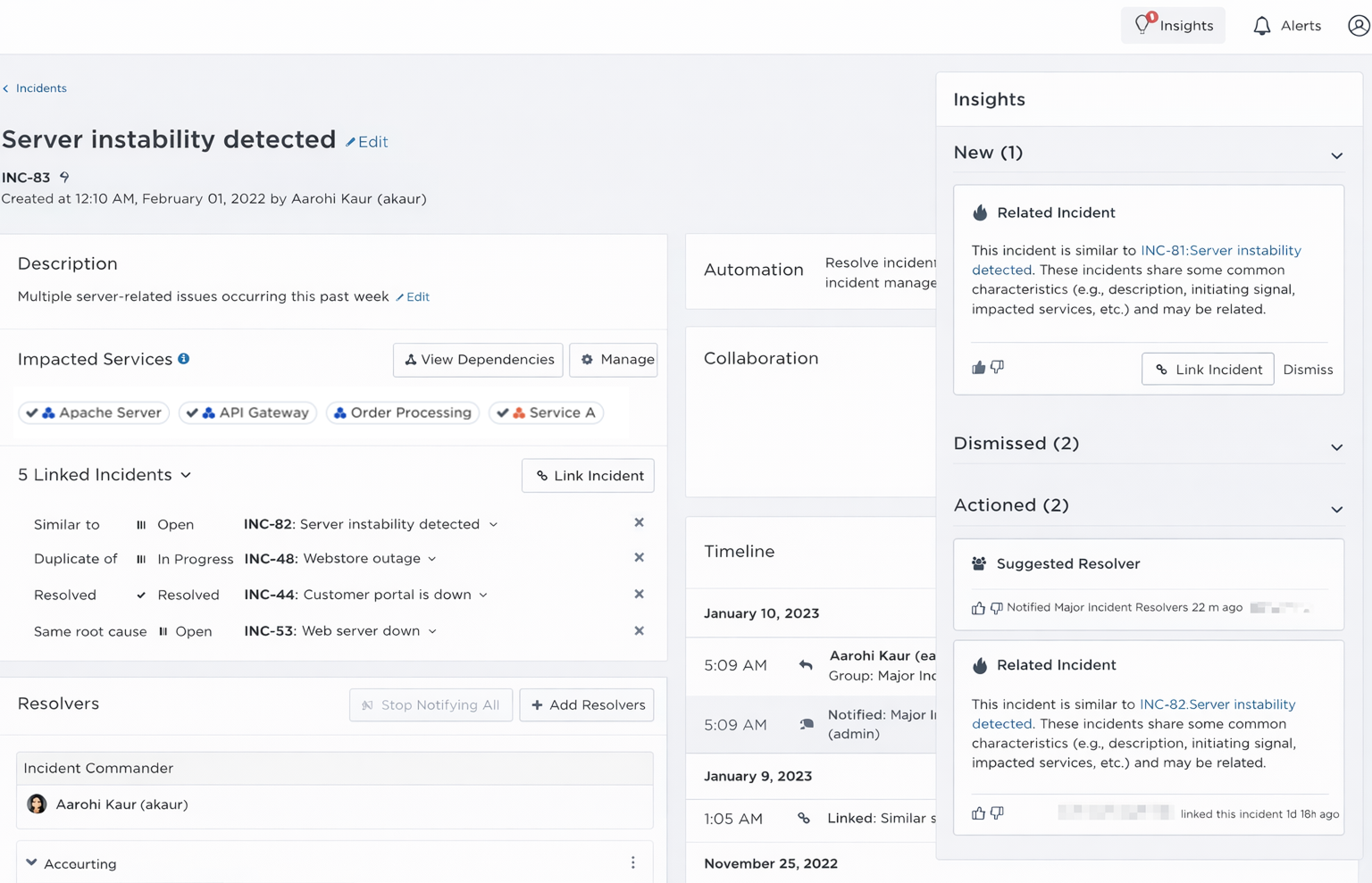
xMatters was evolving beyond alert management toward operational intelligence. Leadership identified an opportunity to introduce Insights — a strategic analytics surface intended to help teams interpret incident patterns, systemic signals, and risk trends.
However:
- The value proposition was broad
- The primary persona was unclear
- The interaction model was undefined
- Assumptions about customer needs were untested
The risk was not feasibility. The risk was investing in the wrong abstraction.
Strategic Context
I was invited into working sessions with the CPO and CTO to shape this initiative from its earliest stage.
Rather than designing screens immediately, my role was to:
- Translate strategic ambition into tangible models
- Surface assumptions early
- Clarify tradeoffs before engineering investment
- Structure ambiguity into decision-ready options
At this stage, the opportunity space was wide.
Concept Exploration
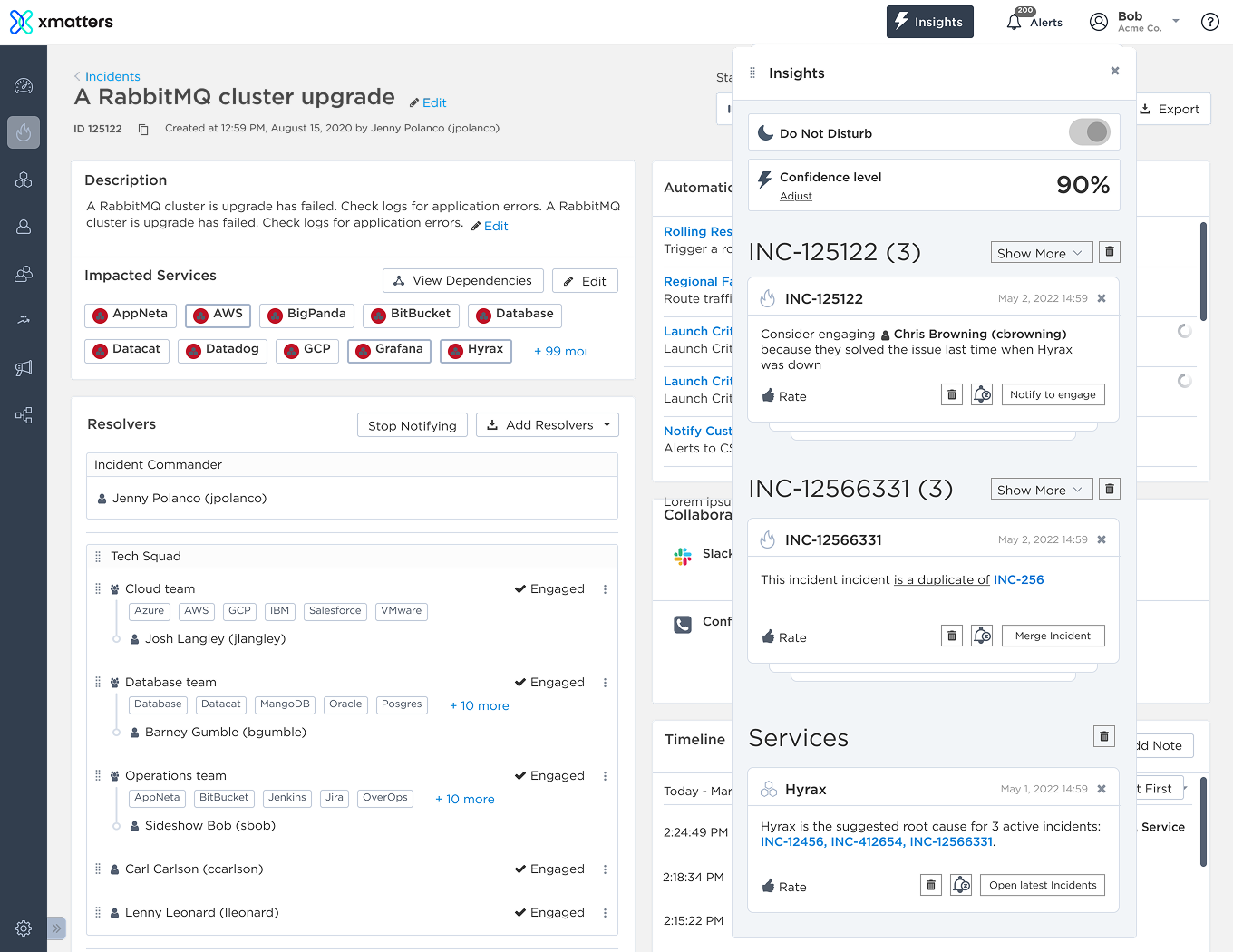
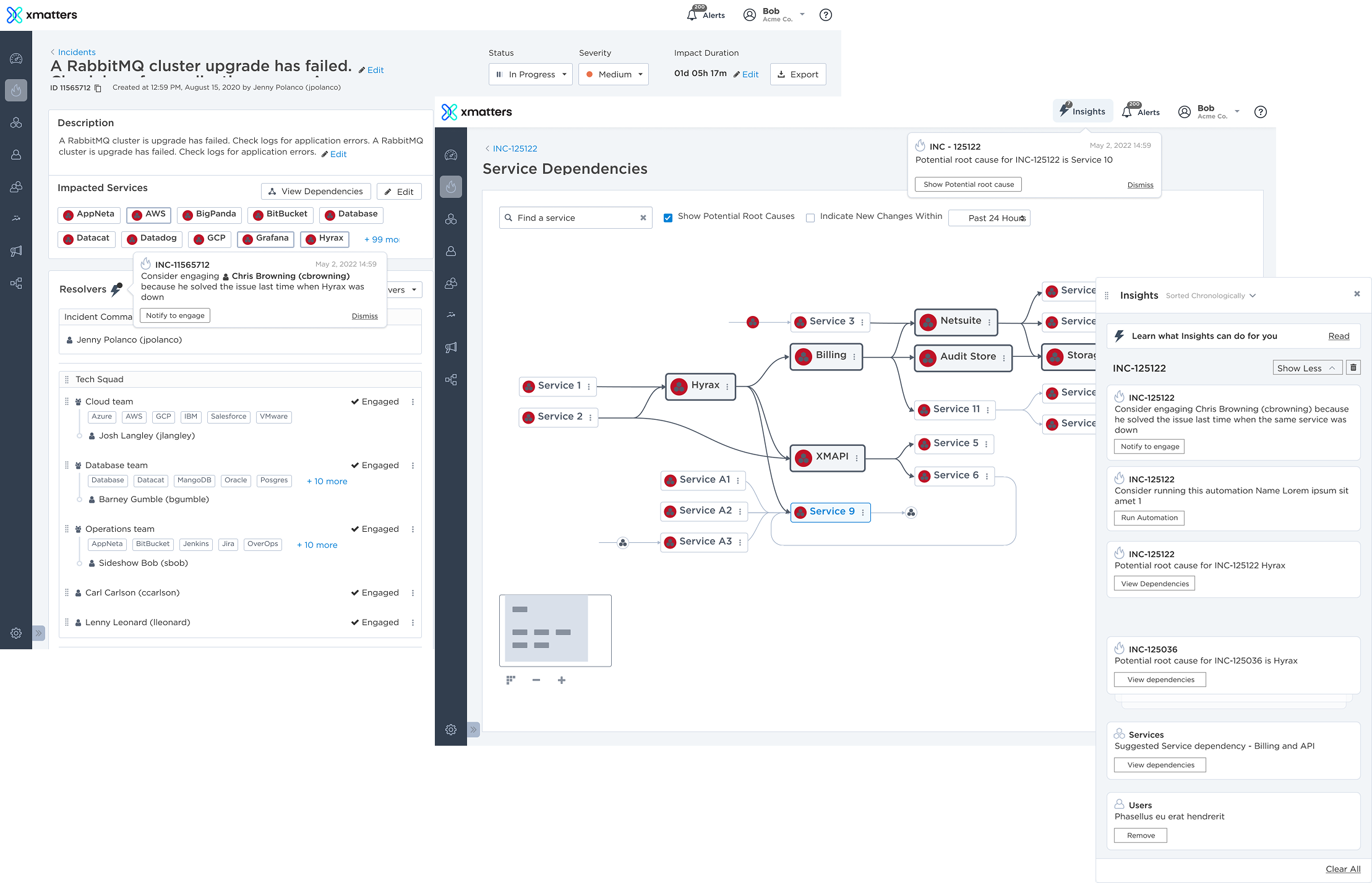
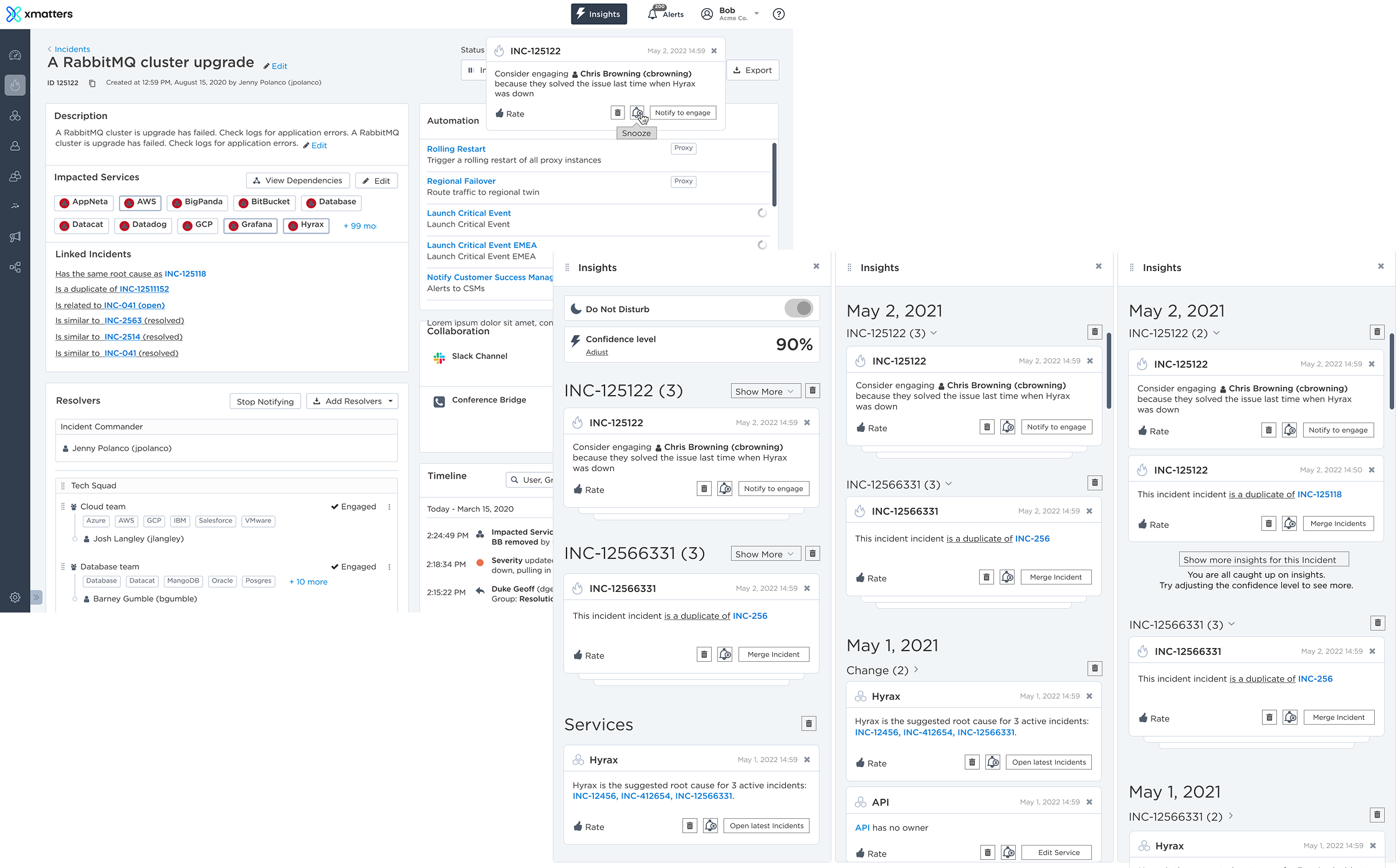
To clarify direction, I created multiple conceptual models for how Insights could function. Early explorations included:
- Incident clustering views (grouped by date, change, or service)
- Duplicate detection surfacing inside incidents
- Suggested root cause relationships
- Confidence scoring indicators
- Service-level pattern aggregation
- Timeline-integrated insights panels
These mocks helped leadership see:
- Whether Insights lived inside incidents or as a standalone surface
- Whether it should emphasize aggregation or recommendation
- How proactive vs reactive it should feel
One direction emerged as the strongest candidate.
Approach
Strategic Reframe
As exploration progressed, the core question shifted. This was not about building a dashboard. It was about defining:
- What decision Insights was meant to support
- Who the true consumer was
- Whether this was operational tooling or executive reporting
- What differentiated it from existing analytics
This reframing shifted the team from layout thinking to product positioning.
Defining the Insight Model
The deeper challenge became: What qualifies as an insight?
We tested and refined:
- Categories of insights
- Grouping and aggregation logic
- Linked incident relationships
- Confidence scoring and trust thresholds
- The balance between summary and contextual depth
Rather than polishing UI, we were defining the ontology of Insights.
Define Scalable Design Patterns
Before committing significant engineering investment, I recommended validating critical assumptions with customers. I translated open questions into:
- Clear hypotheses
- Interactive prototypes
- A structured research script aligned to decision criteria
We tested:
- Individual insight types
- Category logic and grouping
- Linked incident clarity
- Card-level interaction patterns
- Trust calibration around confidence indicators
- Embedded vs standalone placement
Rather than validating aesthetics, we validated positioning and value.
Leadership Through Structure
Throughout the initiative, I:
- Clarified executive assumptions
- Structured exploration into testable models
- Defined validation criteria prior to acceleration
- Prepared research assets and prototypes for continuity
Before my sabbatical, I handed the initiative off to two junior designers with:
- Defined hypotheses
- Structured prototypes
- Clear validation goals
This ensured momentum without ambiguity.
Outcome
- Reduced strategic risk before major investment
- Clarified the role and scope of Insights within the product ecosystem
- Aligned executive ambition with customer validation
- Established a structured continuation plan
This project reinforced that executive-facing design requires defining signal, trust, and decision clarity in ambiguous spaces.
Daria Ershova

Insights
Shaping product direction through executive collaboration
Role: Design Lead (Strategic Contributor)
Scope: Concept development, validation strategy, direction setting, executive collaboration
Context: Early-stage initiative with CPO & CTO
Problem Space
xMatters was evolving beyond alert management toward operational intelligence. Leadership identified an opportunity to introduce Insights — a strategic analytics surface intended to help teams interpret incident patterns, systemic signals, and risk trends.
However:
- The value proposition was broad
- The primary persona was unclear
- The interaction model was undefined
- Assumptions about customer needs were untested
The risk was not feasibility. The risk was investing in the wrong abstraction.
Strategic Context
I was invited into working sessions with the CPO and CTO to shape this initiative from its earliest stage.
Rather than designing screens immediately, my role was to:
- Translate strategic ambition into tangible models
- Surface assumptions early
- Clarify tradeoffs before engineering investment
- Structure ambiguity into decision-ready options
At this stage, the opportunity space was wide.
Concept Exploration
To clarify direction, I created multiple conceptual models for how Insights could function. Early explorations included:
- Incident clustering views (grouped by date, change, or service)
- Duplicate detection surfacing inside incidents
- Suggested root cause relationships
- Confidence scoring indicators
- Service-level pattern aggregation
- Timeline-integrated insights panels
These mocks helped leadership see:
- Whether Insights lived inside incidents or as a standalone surface
- Whether it should emphasize aggregation or recommendation
- How proactive vs reactive it should feel
One direction emerged as the strongest candidate.
Approach
Strategic Reframe
As exploration progressed, the core question shifted. This was not about building a dashboard. It was about defining:
- What decision Insights was meant to support
- Who the true consumer was
- Whether this was operational tooling or executive reporting
- What differentiated it from existing analytics
This reframing shifted the team from layout thinking to product positioning.
Defining the Insight Model
The deeper challenge became: What qualifies as an insight?
We tested and refined:
- Categories of insights
- Grouping and aggregation logic
- Linked incident relationships
- Confidence scoring and trust thresholds
- The balance between summary and contextual depth
Rather than polishing UI, we were defining the ontology of Insights.
Define Scalable Design Patterns
Before committing significant engineering investment, I recommended validating critical assumptions with customers. I translated open questions into:
- Clear hypotheses
- Interactive prototypes
- A structured research script aligned to decision criteria
We tested:
- Individual insight types
- Category logic and grouping
- Linked incident clarity
- Card-level interaction patterns
- Trust calibration around confidence indicators
- Embedded vs standalone placement
Rather than validating aesthetics, we validated positioning and value.
Leadership Through Structure
Throughout the initiative, I:
- Clarified executive assumptions
- Structured exploration into testable models
- Defined validation criteria prior to acceleration
- Prepared research assets and prototypes for continuity
Before my sabbatical, I handed the initiative off to two junior designers with:
- Defined hypotheses
- Structured prototypes
- Clear validation goals
This ensured momentum without ambiguity.
Outcome
- Reduced strategic risk before major investment
- Clarified the role and scope of Insights within the product ecosystem
- Aligned executive ambition with customer validation
- Established a structured continuation plan
This project reinforced that executive-facing design requires defining signal, trust, and decision clarity in ambiguous spaces.
Daria Ershova
Insights
Shaping product direction through executive collaboration
Role: Design Lead (Strategic Contributor)
Scope: Concept development, validation strategy, direction setting, executive collaboration
Context: Early-stage initiative with CPO & CTO
Problem Space
xMatters was evolving beyond alert management toward operational intelligence. Leadership identified an opportunity to introduce Insights — a strategic analytics surface intended to help teams interpret incident patterns, systemic signals, and risk trends.
However:
- The value proposition was broad
- The primary persona was unclear
- The interaction model was undefined
- Assumptions about customer needs were untested
The risk was not feasibility. The risk was investing in the wrong abstraction.
Strategic Context
I was invited into working sessions with the CPO and CTO to shape this initiative from its earliest stage.
Rather than designing screens immediately, my role was to:
- Translate strategic ambition into tangible models
- Surface assumptions early
- Clarify tradeoffs before engineering investment
- Structure ambiguity into decision-ready options
At this stage, the opportunity space was wide.
Concept Exploration
To clarify direction, I created multiple conceptual models for how Insights could function. Early explorations included:
- Incident clustering views (grouped by date, change, or service)
- Duplicate detection surfacing inside incidents
- Suggested root cause relationships
- Confidence scoring indicators
- Service-level pattern aggregation
- Timeline-integrated insights panels
These mocks helped leadership see:
- Whether Insights lived inside incidents or as a standalone surface
- Whether it should emphasize aggregation or recommendation
- How proactive vs reactive it should feel
One direction emerged as the strongest candidate.
Approach
Strategic Reframe
As exploration progressed, the core question shifted. This was not about building a dashboard. It was about defining:
- What decision Insights was meant to support
- Who the true consumer was
- Whether this was operational tooling or executive reporting
- What differentiated it from existing analytics
This reframing shifted the team from layout thinking to product positioning.
Defining the Insight Model
The deeper challenge became: What qualifies as an insight?
We tested and refined:
- Categories of insights
- Grouping and aggregation logic
- Linked incident relationships
- Confidence scoring and trust thresholds
- The balance between summary and contextual depth
Rather than polishing UI, we were defining the ontology of Insights.
Structured Validation
Before committing significant engineering investment, I recommended validating critical assumptions with customers. I translated open questions into:
- Clear hypotheses
- Interactive prototypes
- A structured research script aligned to decision criteria
We tested:
- Individual insight types
- Category logic and grouping
- Linked incident clarity
- Card-level interaction patterns
- Trust calibration around confidence indicators
- Embedded vs standalone placement
Rather than validating aesthetics, we validated positioning and value.
Leadership Through Structure
Throughout the initiative, I:
- Clarified executive assumptions
- Structured exploration into testable models
- Defined validation criteria prior to acceleration
- Prepared research assets and prototypes for continuity
Before my sabbatical, I handed the initiative off to two junior designers with:
- Defined hypotheses
- Structured prototypes
- Clear validation goals
This ensured momentum without ambiguity.
Outcome
- Reduced strategic risk before major investment
- Clarified the role and scope of Insights within the product ecosystem
- Aligned executive ambition with customer validation
- Established a structured continuation plan
This project reinforced that executive-facing design requires defining signal, trust, and decision clarity in ambiguous spaces.